When AI large language models complete training in just a few hours and autonomous driving systems process massive amounts of data in real time, 800G optical transceivers are the indispensable high-speed transmission foundation behind these scenarios. They are a core component supporting the operation of global digital infrastructure and play a crucial role.

In recent years, the global 800G optical transceiver market has experienced a significant supply-demand gap, with demand soaring. Against this backdrop, professional module manufacturers’ 800G products precisely meet core market needs, the products cover mainstream scenarios such as short-distance interconnects within data centers, and their high compatibility with industry standards makes them a reliable choice for numerous network deployments.
Why Are 800G Optical Transceivers Indispensable for AI?
Fiber optic transceivers are responsible for converting electrical signals to optical signals, directly determining data transmission efficiency, and their role is becoming increasingly critical in the AI era.
800G fiber transceivers have overcome data transmission bottlenecks. Training models with hundreds of billions of parameters requires transmitting tens of petabytes of data. Compared to the previously mainstream 400G transceivers, 800G transceivers can halve the time required for similar tasks, while also reducing latency by half and significantly lowering the risk of bit errors.
800G fiber transceivers are essential for significantly upgraded computing infrastructure. The shipment volume of high-performance AI chips continues to surge, and each AI server equipped with high-end chips requires at least 4-6 800G fiber optic transceivers to operate at full capacity. Without their support, the computing power of advanced chips cannot be fully utilized.
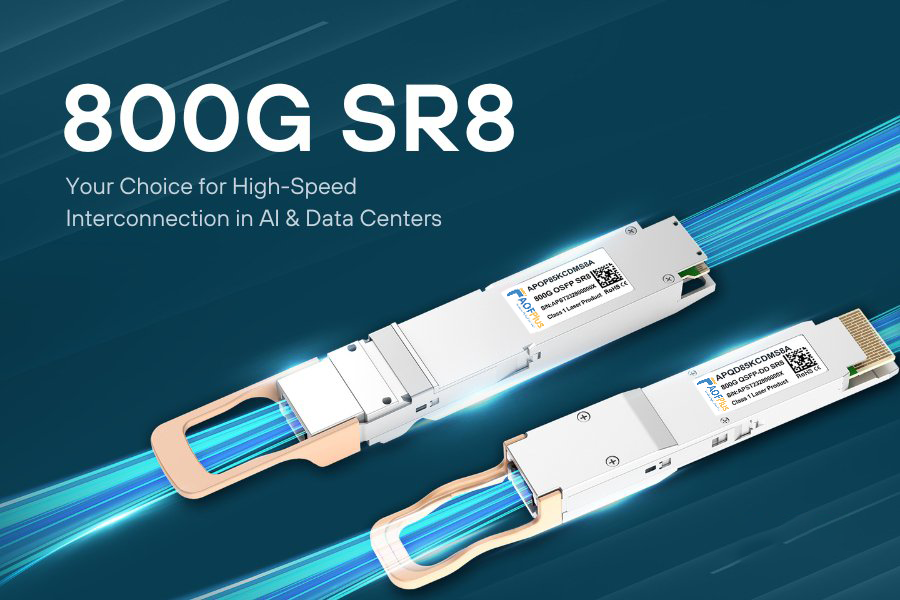
High Performance of 800G Optical Transceivers
The high-speed performance of 800G fiber transceivers stems from a precisely coordinated technological system, embodying cutting-edge achievements in photonics and electronics.
Firstly, 800G transceiver modules achieve high-precision signal conversion and modulation. Through laser diodes and photodiodes, they achieve low bit error rate signal conversion, combined with advanced PAM4 modulation and FEC technology, ensuring that even at ultra-high speeds of 800G, the number of errors does not exceed 1 in every 10¹² bits.
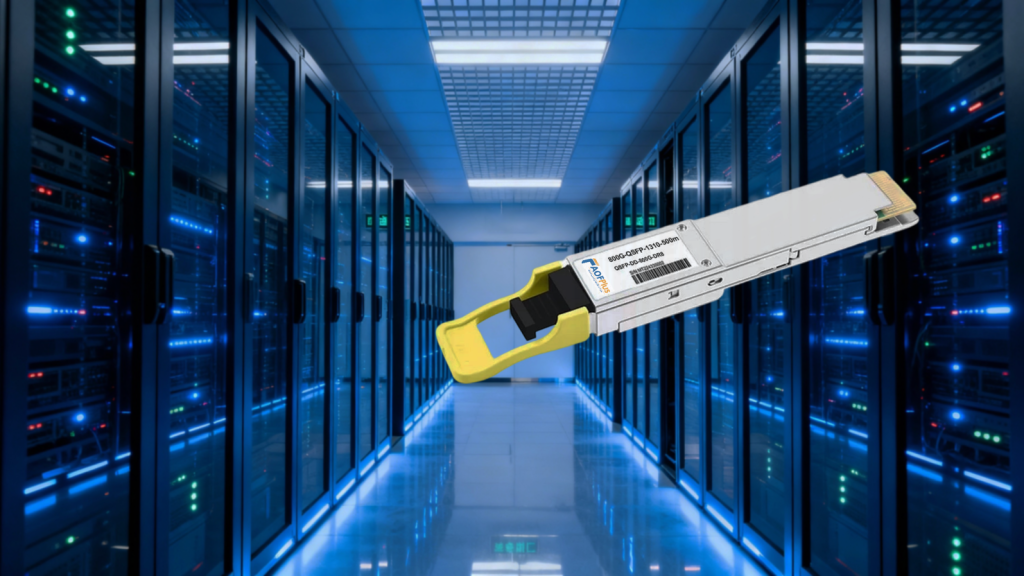
800G transceiver modules offer broad compatibility with mainstream packaging types. Currently, QSFP-DD and OSFP are the core packaging types for 800G fiber transceiver, with OSFP accounting for 58% of the market share in hyperscale data centers due to its superior heat dissipation performance and more stable high-speed signal transmission. Many companies accurately grasp market demand and have strategically invested in mainstream technologies such as OSFP packaging, forming a product matrix that aligns with industry applications.
The practical design of 800G transceivers supports efficient operation and maintenance. 800G optical transceivers generally support hot-swapping and digital diagnostic monitoring functions, allowing for component replacement and real-time monitoring of operating status without shutting down data center power, significantly reducing downtime costs for maintenance and upgrades. This design feature, adapted to industrial scenarios, is fully reflected in mainstream 800G products in the industry.
The Future Trend: Moving Towards Higher Speeds And Broader Applications
The widespread adoption of 800G transceiver modules is just the beginning; 1.6T optical transceivers have already entered the trial production stage, and co-packaged optics (CPO) technology is accelerating in development. Companies in the industry are continuously iterating based on their existing technological expertise, and product application scenarios are expanding from AI data centers to a wider range of fields, laying a solid foundation for the digital future of “connecting everything with transceiver.”
Conclusion
800G fiber optic transceivers are of great significance in the AI era. By providing ultra-high-speed data transmission, they support big data processing, low-latency computing, and efficient network interconnection, driving the development of data centers and edge computing. In addition to 800G fiber optic transceiver, AOFPLUS also offers 40G, 100G, 200G, and 400G fiber optic transceivers.