Optical transceivers can be classified 1.25G SFP, 10G SFP+, 25G SFP28, 40G QSFP+, 100G QSFP28, 200G QSFP56, 400G OSFP, 800G OSFP etc. But what is a CWDM optical transceiver, and what are its applications and advantages? Do you know?
What is A CWDM Optical Transceiver?
A CWDM optical transceiver is a device used in fiber optic networks to increase bandwidth capacity by transmitting multiple data signals simultaneously over a single optical fiber, using different wavelengths (colors) of light for each signal.
The term “coarse” refers to the wide 20 nanometer (nm) spacing between these different wavelengths, typically in the 1270 nm to 1610 nm range. This wide spacing allows for the use of less complex, non-cooled lasers and simpler filtering technology, making CWDM systems a cost-effective solution for short to medium-range network expansion (up to 80 km).
CWDM 1.25G SFP Optical Transceiver
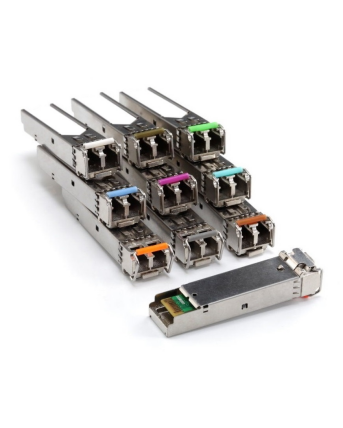
1.25G SFP optical transceivers combine the space-saving advantages of SFF with the flexibility of GBIC. They have the compact size of SFF modules while retaining the functionality of GBIC modules. In addition to their size advantage, 1.25G SFP optical transceivers also feature low power consumption because they operate at 3.3V, compared to 5V for GBIC modules. Furthermore, 1.25G SFP optical transceivers provide power, temperature, and voltage level monitoring capabilities. With technological advancements, and combining both functional and size advantages, CWDM and DWDM 1.25G SFP transceivers have been applied in Gigabit Ethernet and 2.5Gbps SONET applications. In addition, 1.25G SFP optical transceivers have also been developed for 1, 2, and 4 Gbps Fibre Channel applications.
CWDM 10G SFP+ Optical Transceiver
The CWDM 10G SFP+ ZR optical transceiver is a “limiting module” designed for 10G Ethernet and 2G/4G/8G/10G Fibre Channel applications. The optical transceiver consists of two parts: the transmitter section contains a cooled EML laser. The receiver section consists of an APD photodiode and a TIA. All modules meet laser safety requirements.
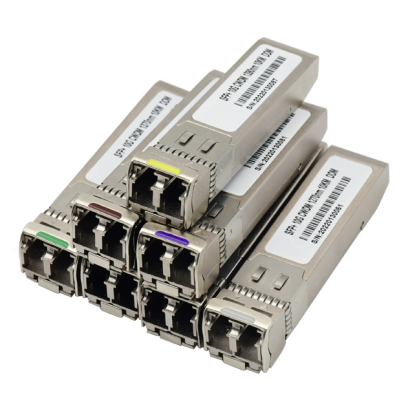
CWDM 10G SFP+ optical transceivers modules offer robust advantages for modern networks: they support 10 Gbps high-speed data transmission, enabling seamless handling of bandwidth-heavy workloads in data centers, cloud environments and network-intensive industries. Leveraging CWDM technology, these optical transceivers modules achieve superior fiber utilization by multiplexing multi-wavelength signals onto a single fiber, cutting costs by maximizing existing infrastructure without extra cabling. They also deliver flexible scalability—compatible with diverse networking gear, they allow easy capacity expansion as needs grow, without costly overhauls. Additionally, their compact form factor streamlines installation, maintenance and hot-swapping, optimizing rack space and reducing network footprint, while their low-power design lowers energy consumption and operational costs, outperforming traditional DWDM solutions in energy efficiency.
Applications of CWDM Optical Transceivers
CWDM optical transceivers serve as a cost-efficient solution to expand fiber bandwidth for short-to-medium haul transmissions across enterprise, carrier, and data center networks. By enabling the simultaneous transmission of multiple heterogeneous data streams—including Gigabit Ethernet, high-definition video, and VoIP traffic—over a single fiber strand, these modules facilitate seamless connectivity for campus backbones, metropolitan area networks (MANs), and fiber-to-the-home (FTTH) access networks. Valued for their low deployment costs and simplified management, CWDM optical transceivers have become a go-to choice for bandwidth scaling in legacy fiber infrastructure, supporting data center interconnect (DCI) for cloud-to-on-premises integration, and empowering internet service providers (ISPs) to extend high-speed services to end users. Their versatility further extends to critical use cases such as security and surveillance systems (for real-time video feed transport) and CATV networks (for high-capacity video content distribution), making them a versatile cornerstone of modern optical communication architectures.
Conclusion
CWDM optical transceivers utilize wavelength division multiplexing technology to achieve efficient utilization of fiber optic resources, offering advantages such as low cost, high bandwidth, and strong compatibility, making them an ideal solution for metropolitan area networks and data center interconnects.