The Brief Introduction of CWDM Optical Transceivers
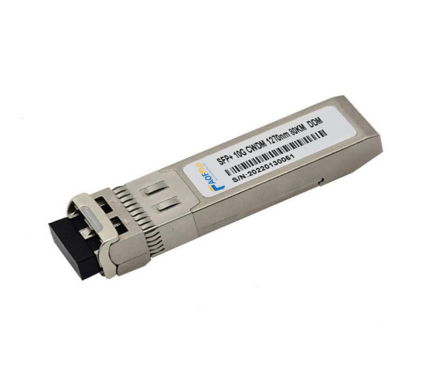
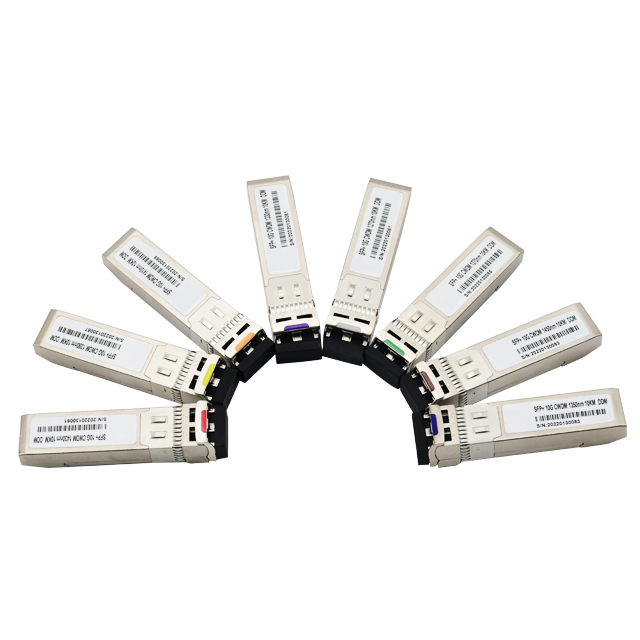
A CWDM fiber optic transceiver (Coarse Wavelength Division Multiplexing) is a compact device that plugs into network gear (like switches/routers). A CWDM transceiver works by transmitting and receiving data over different wavelengths (frequencies) of light using the same optical fiber. Each wavelength can carry a separate data stream, effectively multiplying the total bandwidth of the fiber. It is very cost-effective for expanding network capacity, and enable carriers, enterprises, and data centers to increase bandwidth without laying new fibers, supporting applications like Ethernet, Fibre Channel, and SONET/SDH.
The CWDM optical transceiver is commonly available as SFP (1G), SFP+ (10G)modules. It supports a broad range of data transmission speeds, spanning from as low as 155 Mbps to as high as 10 Gbps, making it suitable for a variety of network needs. Typically, it is employed in medium to long-haul applications, offering flexible transmission distances that range from 10 km and 20 km, to 40 km, 80 km, and even up to 160 km, depending on the specific use case and network requirements. The CWDM optical transceiver operates by utilizing distinct channels that are spaced 20 nm apart, with standard wavelengths including 1270 nm, 1290 nm, and 1310 nm, among others.
The Advantages of CWDM Optical Transceivers
CWDM fiber transceivers offer many significant advantages. Firstly, they are highly cost-effective, with low equipment costs, making them particularly suitable for cost-sensitive applications such as 5G fronthaul network construction. Compared to DWDM, CWDM transceiver modules are energy-efficient and consume less power, eliminating the need for semiconductor coolers and temperature control, thus significantly reducing power consumption. They also improve fiber utilization by transmitting multiple channels over a single fiber, maximizing savings on fiber deployment costs. CWDM fiber optic transceivers also offer networking flexibility and strong scalability, providing multiple wavelength channels (typically 18, from 1270nm to 1610nm), facilitating the addition and expansion of services. Furthermore, they offer transparent transmission for various services (such as Ethernet and SDH/SONET), without affecting service protocols. Finally, CWDM optical transceivers utilize compact packaging (such as SFP/SFP+), saving valuable data center space.
The Applications of CWDM Optical Transceivers
CWDM transceiver modules are primarily used in various short-to-medium distance, low-to-medium capacity fiber optic networks, such as metropolitan area networks/access networks, enterprise networks, data center interconnects (DCI), FTTH, 5G fronthaul, security surveillance, and cable television networks. By multiplexing multiple signals of different wavelengths onto a single optical fiber, they enable the saving of fiber resources and the expansion of network capacity, making them particularly suitable for scenarios requiring flexible deployment and cost-sensitive solutions.

Key Factors To Choose CWDM Optical Transceivers
What aspects should be considered when selecting CWDM fiber transceivers? First, choose the appropriate transmission distance based on your network requirements. CWDM fiber optic transceivers are suitable for short-distance transmission and are generally used in Gigabit Ethernet and point-to-point networks. Second, select the appropriate package type of CWDM transceiver based on network bandwidth requirements. For example, in Gigabit Ethernet, you can choose SFP CWDM fiber optic transceivers; for 10G Ethernet, choose SFP+ CWDM fiber transceivers. When selecting CWDM optical transceivers, compatibility should also be considered. Ensure that the selected CWDM optical transceiver is compatible with your network equipment, including interface type and transmission standards. In addition, when selecting CWDM fiber optic transceivers, you need to confirm the required wavelength channels. CWDM typically provides a wavelength range from 1270nm to 1610nm, with a total of 18 bands. Choosing the correct wavelength is crucial to ensuring the accuracy of signal transmission. Also, choose the appropriate package type based on your device interface, such as SFP, SFP+, or QSFP+. What’s more, when selecting CWDM fiber optic transceivers, you should also consider the operating temperature of the transceiver module, ensuring that the selected transceiver can operate stably within the specified temperature range.
Conclusion
CWDM fiber optic transceivers provide an efficient, cost-effective solution for enhancing network capacity while optimizing fiber resource utilization. Their advantages, including low power consumption, flexible networking options, and transparent transmission, make them ideal for a wide range of applications, metropolitan area networks, and data center interconnections. When selecting CWDM optical transceivers, it is essential to consider factors such as transmission distance, bandwidth requirements, compatibility, wavelength channels, and operating temperature to ensure optimal performance and scalability. With their versatility and cost-effectiveness, CWDM transceiver modules continue to play a crucial role in supporting the ever-growing demands of modern telecommunications networks.