Wavelength Division Multiplexing (WDM) technology is a technique used to address the shortage of fiber optic resources. Its main purpose is to increase the available bandwidth of optical fibers without the need to lay more fibers. CWDM and DWDM are two types of WDM technologies commonly used in telecommunications applications, primarily in wavelength division multiplexers/demultiplexers. Wavelength division multiplexers need to be used in conjunction with WDM fiber optic transceivers. This article mainly explains the differences between CWDM and DWDM optical transceivers.
What Are CWDM Optical Transceivers?
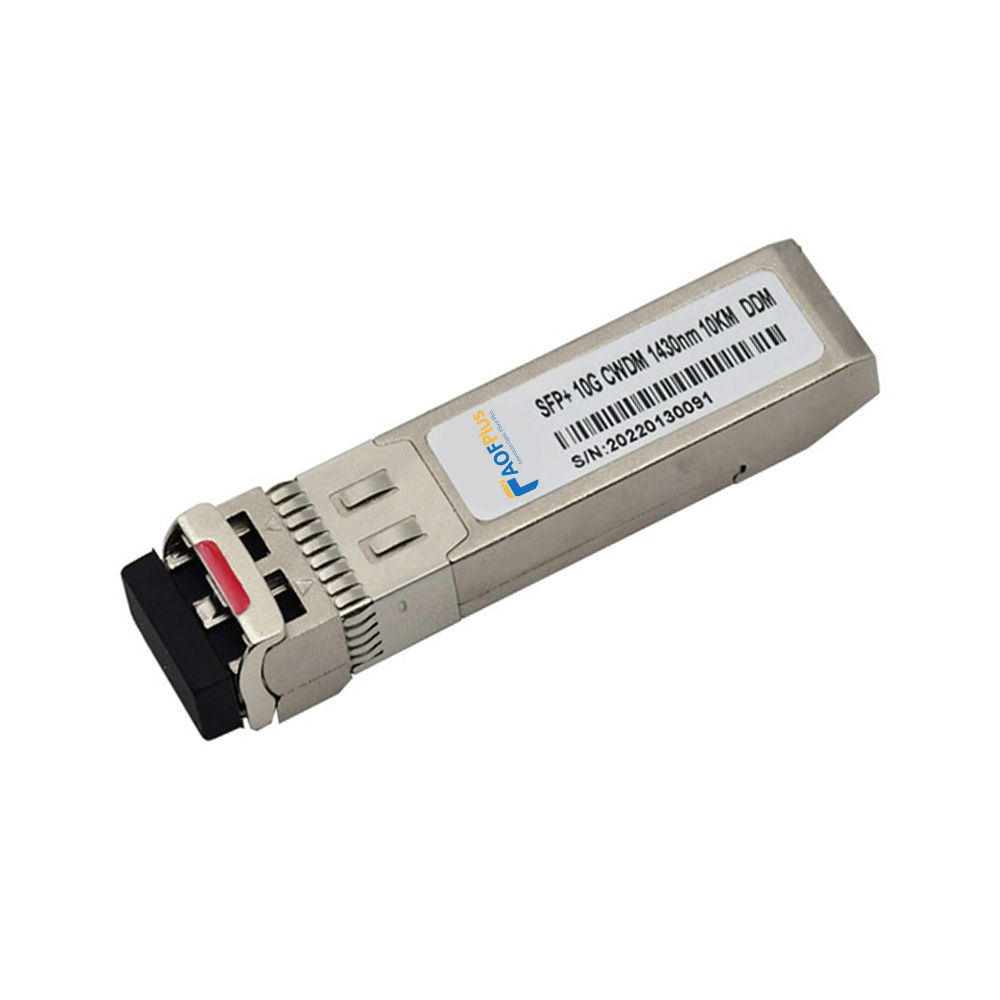
CWDM (Coarse Wavelength Division Multiplexing) fiber optic transceivers utilize CWDM technology and are a low-cost WDM transmission technology for metropolitan area network access layers. In principle, CWDM uses an optical multiplexer to combine optical signals of different wavelengths onto a single optical fiber for transmission. At the receiving end of the link, an optical demultiplexer separates the mixed signals in the fiber into signals of different wavelengths, which are then connected to the corresponding receiving equipment. It’s wavelength range is 1270 to1610nm, and the front wavelengths is 1270 to 1450nm, rear wavelengths is 1470 to 1610nm, with a 20nm interval between each wavelength band.
What Are DWDM Optical Transceivers?
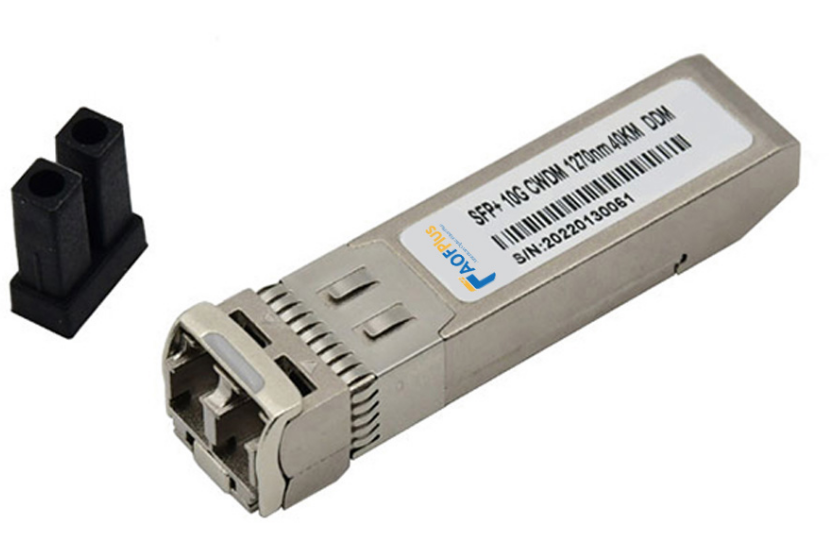
DWDM (Dense Wavelength Division Multiplexing ) transceiver modules are a type of optical module that utilizes Dense Wavelength Division Multiplexing (DWDM) technology. They multiplex multiple optical signals of different wavelengths onto a single optical fiber, significantly increasing fiber capacity. They are primarily used in long-distance, high-capacity backbone networks and metropolitan area networks to address bandwidth expansion needs. They carry data using closely spaced wavelengths (such as 0.4nm, 0.8nm, 1.6nm) and support pluggable, tunable, and high-speed transmission over distances exceeding 100 kilometers.
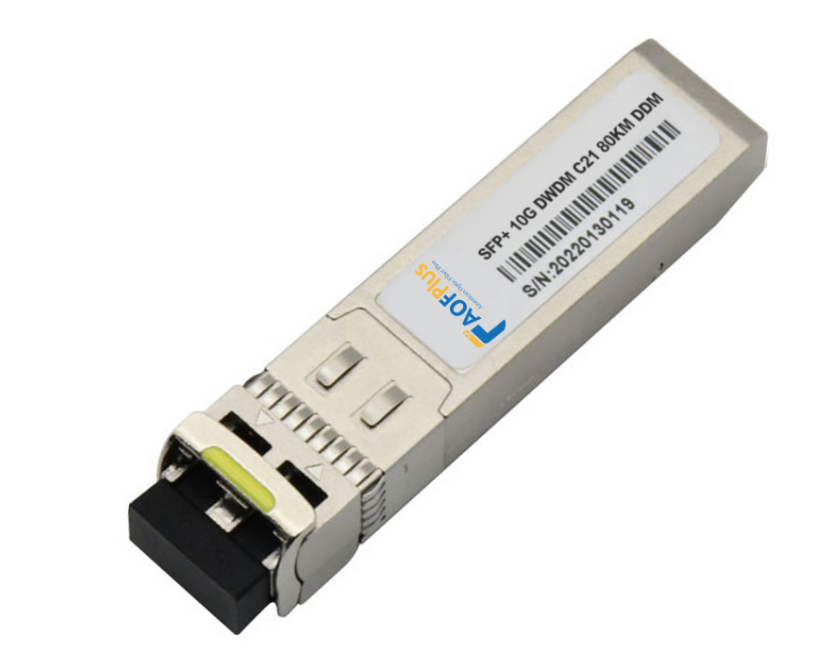
Difference in Wavelength Range Between CWDM And DWDM Optical Transceivers
CWDM transceiver modules operate in the wavelength range of 1270–1610nm, with a channel spacing of 20nm, offering 18 selectable channels. The 1470–1610nm band is commonly used, with typical transmission distances of 40KM, 80KM, and 120KM. CWDM optical transceivers support transmission rates of 155M, 1.25G, and 10G, corresponding to SFP, SFP+/XFP packaging types, respectively.
DWDM fiber transceivers operate in the C-band (C17–C61), with wavelengths ranging from 1563.86 to 1528.77 nm and a channel spacing of 0.8 nm. There are 45 channels available, and common transmission distances are 40 km and 80 km.
Difference in Application Scenarios Between CWDM And DWDM Optical Transceivers
CWDM (Coarse Wavelength Division Multiplexing) and DWDM (Dense Wavelength Division Multiplexing) optical transceivers differ in their application scenarios, primarily in terms of transmission distance, bandwidth requirements, and cost.
CWDM transceivers are mainly used in short-to-medium distance fiber optic networks with low-to-medium bandwidth requirements, suitable for metropolitan area networks (MANs), access networks, enterprise networks, and data center interconnects. Furthermore, because their cost is lower, the CWDM optical transceivers are particularly suitable for cost-sensitive applications that do not require long-distance transmission.
DWDM transceivers, on the other hand, are suitable for networks requiring long distances, high bandwidth, and large capacity, such as metropolitan area networks, long-haul backbone networks, and submarine fiber optic cables. DWDM optical transceivers offer higher wavelength density (tens to hundreds of wavelengths) and support longer transmission distances (typically hundreds to thousands of kilometers). They are widely used in inter-city connections, high-density data transmission, and large-scale network expansion scenarios.
Difference in Wavelength Division Multiplexers Between CWDM And DWDM Optical Transceivers
CWDM optical transceivers need to be used in conjunction with CWDM multiplexers and demultiplexers to achieve optical network interconnection; DWDM fiber transceivers need to be used in conjunction with DWDM multiplexers and demultiplexers to achieve optical network interconnection.
Difference in Lasers between CWDM And DWDM Optical Transceivers
DWDM fiber optic transceivers require cooled lasers (temperature-controlled) to prevent wavelength drift due to temperature changes, which could cause the wavelength to fall outside the filter channels of the multiplexer and demultiplexer. CWDM transceiver modules, on the other hand, use uncooled lasers (electronically controlled).
Conclusion
CWDM and DWDM optical transceivers have many differences but have their own advantages, making them suitable for different network requirements. CWDM fiber optic transceivers is a cost-effective solution for short-to-medium distance applications, offering multiple channels with wider spacing, making it ideal for metropolitan area networks and access networks. On the other hand, DWDM transceivers, with their high channel density and ability to support long-distance, high-capacity transmissions, are best suited for backbone networks and large-scale intercity connections. Therefore, the choice of which fiber optic transceiver to use depends on the specific requirements.