In modern high-speed network communication, optical transceivers play a crucial role. They are key components that enable the conversion between electrical and optical signals, allowing data to be transmitted at high speeds over fiber optic networks. SFP and QSFP transceivers are two common types of optical transceivers, and they differ significantly in performance, size, power consumption, and application scenarios.
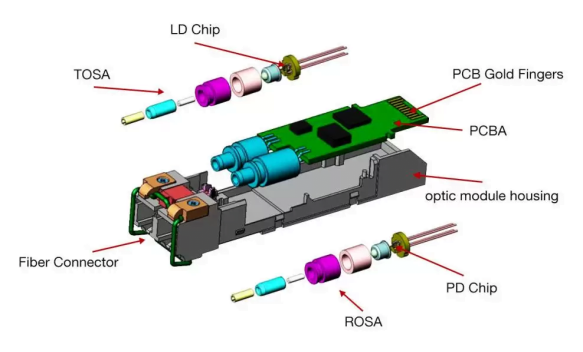
Dimensions and Interfaces
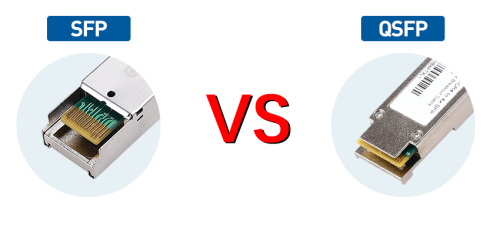
The SFP optical transceiver module is a compact, pluggable device with dimensions of 10×10 mm, hence the name “Small Form-factor Pluggable”. Featuring a space saving design, SFP transceivers are ideal for space-constrained environments. They are typically used for data transmission speeds at or below 10 Gbps.
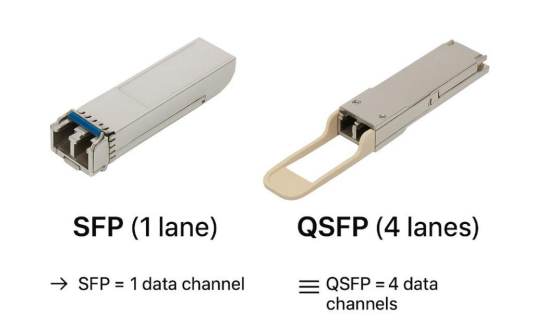
The QSFP optical transceiver is a four-channel, small form-factor pluggable transceiver module with a size of 14x14mm, hence the name “Quad Small Form-factor Pluggable.” QSFP transceivers integrate four independent channels into a single module, each capable of operating independently, thus achieving higher data transmission rates.
Data Transfer Rate
SFP optical transceivers were originally designed for a data transmission rate of 1 Gbps, but with technological advancements, SFP+ transceivers supporting 10 Gbps are now also available. SFP transceivers transmit data through a single channel, therefore their maximum transmission rate is limited by the bandwidth of that single channel.
QSFP optical transceivers modules support higher data transmission rates and are typically used in 40Gbps or 100Gbps applications. Because QSFP transceivers modules have four independent channels, each capable of transmitting 10Gbps of data, they can achieve a transmission rate of 40Gbps when all four channels work together. With technological advancements, QSFP28 transceivers are now capable of supporting 100Gbps data transmission rates.
Power Consumption
Because SFP optical transceivers have only one channel, their power consumption is relatively low. This makes SFP transceivers more suitable for power-sensitive applications, such as in environments with limited power supply.
Due to integrating four channels, QSFP optical transceivers have relatively high power consumption. However, with technological advancements, the power consumption of QSFP transceivers modules has been significantly reduced, making them more competitive in high-performance applications.
Application of SFP and QSFP Optical Transceivers
SFP optical transceivers are commonly used in small devices or in applications where space is limited due to their small size and low power consumption. They are very common in 10Gbps Ethernet, Fibre Channel, and other high-speed networking applications.
QSFP optical transceivers, due to their high data transmission rates and multi-channel capabilities, are widely used in data centers, high-performance computing, and high-speed network switches. With the ever-increasing demand for bandwidth in data centers, QSFP optical transceivers are becoming increasingly prevalent in 40Gbps and 100Gbps Ethernet applications.
Costs and Prices
Due to their mature technology and widespread application, SFP optical transceivers are typically low-cost and relatively inexpensive. This makes SFP optical transceivers more attractive for projects with limited budgets.
Due to their higher integration and more complex technology, QSFP optical transceivers modules have relatively higher costs and prices. However, with the maturation of the technology and large-scale production, the cost of QSFP optical transceivers is gradually decreasing.
Compatibility and Standardization
Both SFP and QSFP optical transceivers adhere to strict industry standards to ensure compatibility between transceivers from different manufacturers. SFP transceivers follow the SFF-8472 standard, while QSFP transceivers modules follow the SFF-8436 standard. These standards define the physical dimensions, electrical interfaces, and hot-swappable characteristics of the transceivers, ensuring compatibility between different devices.
Technological Development
With the development of network technology, SFP and QSFP optical transceivers are constantly evolving. For example, SFP transceivers have evolved into versions such as SFP+ and SFP28 to support higher data transmission rates. QSFP transceivers modules have also evolved into versions such as QSFP+ and QSFP28 to meet different application requirements.
Conclusion
SFP and QSFP optical transceivers each have their own advantages and play important roles in different application scenarios. SFP optical transceivers, with their compact size, low power consumption, and lower cost, dominate in applications at speeds of 10Gbps and below. QSFP optical transceivers, on the other hand, are becoming increasingly popular in 40Gbps and 100Gbps applications due to their high data transmission rates and multi-channel capabilities. As network bandwidth demands continue to grow, the importance of QSFP optical transceivers modules will become even more pronounced.